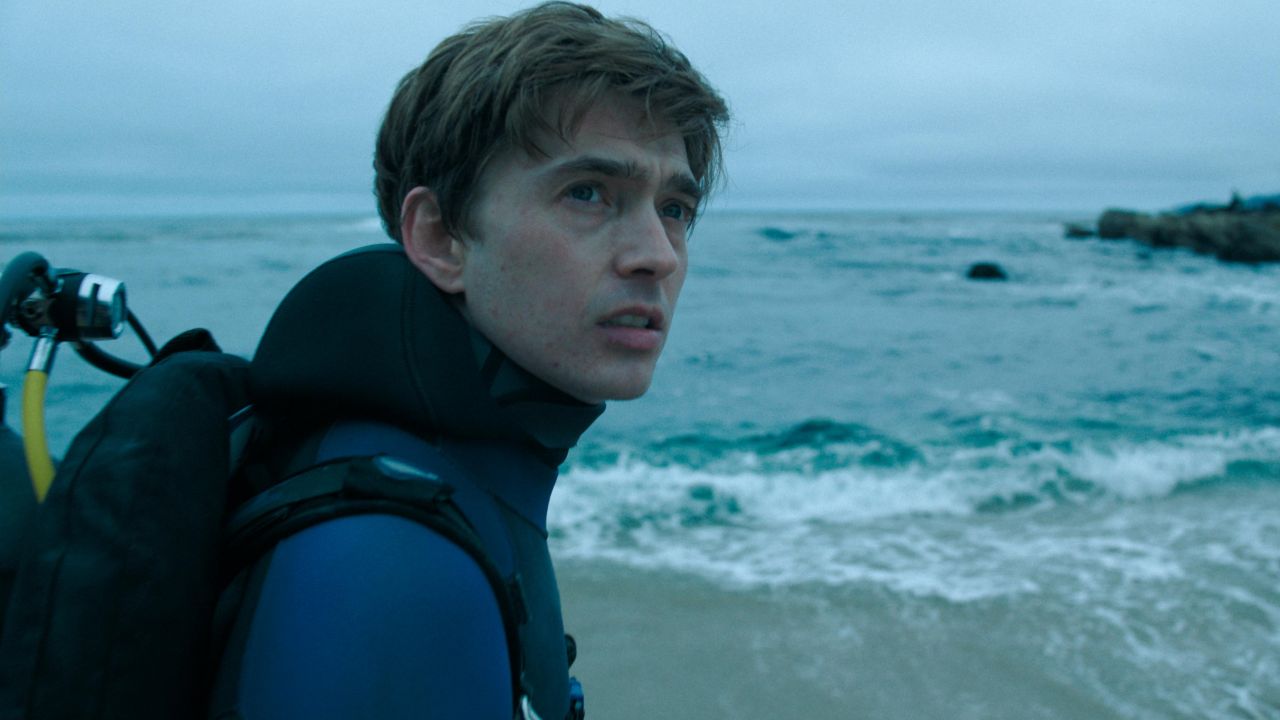
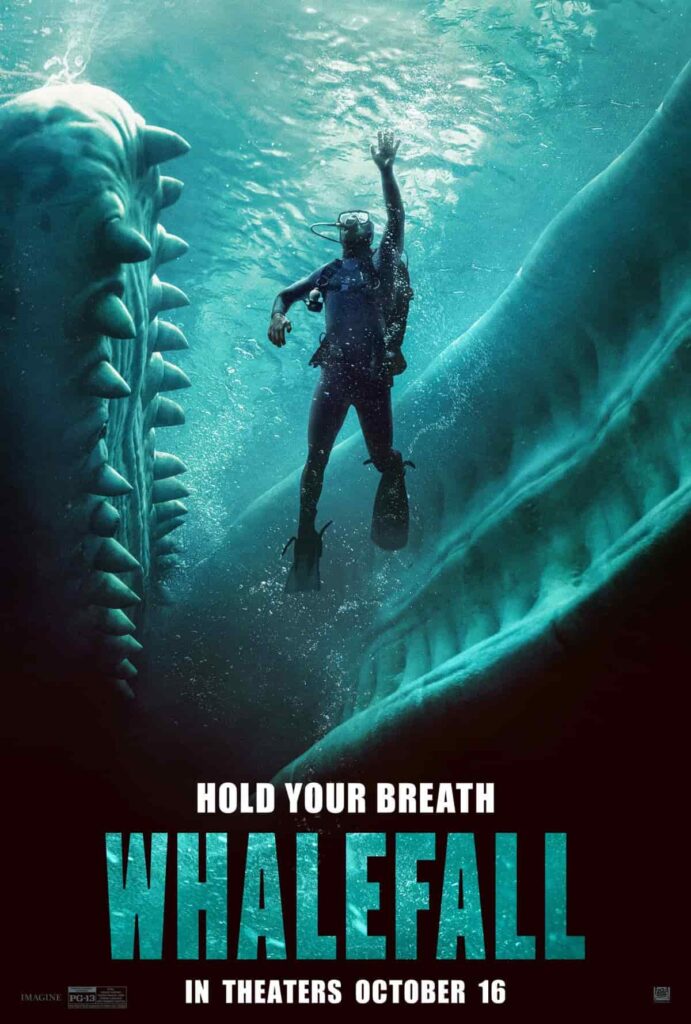
Whalefall takes an almost absurdly simple nightmare—a diver swallowed alive by a sperm whale—and treats it with the scale and seriousness of a survival epic.
Directed by Brian Duffield and starring Austin Abrams opposite Josh Brolin, the 20th Century Studios thriller turns a one-hour oxygen clock into both physical suspense and a bruising father-son story.
Jay Gardiner dives off California’s Central Coast in search of his late father’s remains, only to be swallowed by an enormous sperm whale.
Trapped inside with limited oxygen, he must use lessons inherited from the father he resented if he wants any chance of escaping.
Behind that claustrophobic premise was a production full of practical effects, moving organic sets, puppetry, water rigs, and one lead actor carrying almost the entire movie on his shoulders.
Read: 8 Facts About Clayface, Liverpool Became Gotham Once Again
1. The Crew Literally Spent a Summer “Inside a Whale” on a Studio Stage
The central location was not just a digital environment. Brian Duffield said the cast and crew spent a summer working inside a constructed whale interior on a soundstage in Studio City, California, building as much physical reality around Austin Abrams as possible.
That decision was essential to the movie’s tone. Rather than asking Abrams to perform almost everything against empty green walls, the production surrounded him with surfaces he could touch, crawl through, slip against, and physically fight. For a thriller depending on confinement, the set itself became one of the actor’s scene partners.
2. The Whale’s Stomach Was Built to Move With Its Heartbeat
The stomach was designed as living tissue, not a static cave. Because a sperm whale’s heart sits close to the stomach, the practical environment was engineered to react rhythmically as though the animal’s heartbeat were physically passing through the walls around Jay.
That subtle movement matters because the audience is supposed to feel that Jay is trapped inside a living creature, not a fantasy cavern.
Every pulse reinforces the same uncomfortable fact: the place trying to crush and digest him is also breathing, circulating blood, and continuing its life around him.
3. Water Pistons Made the Set Behave Differently From Take to Take
The whale interior was mechanically unpredictable. Water pistons were used to simulate seawater entering the animal, while the stomach was repeatedly filled and drained during production.
The process could alter the physical shape of the set so dramatically that carefully prepared storyboards and previs sometimes stopped matching what the filmmakers found the next morning.
Duffield called the stomach a “diva,” and the description fits. The filmmakers were trying to control a set deliberately built to feel unstable, wet, organic, and alive.
That instability made production harder, but it also prevented the environment from ever looking too clean or mechanically repeatable.
4. A Practical Giant Squid Puppet Was Inside the Whale Too
Being swallowed by an enormous sperm whale was apparently not enough trouble for Jay. Whalefall also places a squid inside the creature with him, and that threat was represented on set by a physical puppet rather than existing only as a computer-generated effect.
The practical-effects team at Wētā Workshop built the squid element for the production. It gave Abrams another tangible object to react against while keeping the whale interior crowded with the strange biological debris and creatures audiences might imagine inside something that enormous.
5. The Movie Is Almost Entirely Austin Abrams in Survival Mode
Duffield estimated that roughly 95 percent of the movie is essentially Austin Abrams being placed in increasingly extreme situations.
The film spends long stretches without cutting away from the whale, with only occasional flashbacks opening the story back up to Jay’s relationship with his father.
That means the survival thriller depends unusually heavily on one performer sustaining fear, exhaustion, grief, problem-solving, and physical strain without a conventional ensemble sharing the dramatic burden.
Abrams described the production as some of the most physical work of his career, involving climbing, underwater work, and prolonged time inside the fabricated whale environment.
Read: 9 Sacrifice Facts, Chris Evans Turns His Star Image Into Satire
6. Duffield Deliberately Avoided “Fancy” Camera Work
A premise this visually strange could have encouraged flashy camera tricks. Duffield chose the opposite approach.
His priority was making viewers feel trapped beside Jay, so he intentionally pushed away elaborate stylistic flourishes that might remind the audience they were watching a constructed set piece.
The camera therefore stays focused on Abrams, the limited space around him, and the immediate physical problem.
The effect is less like observing a giant creature from a safe distance and more like being swallowed with the protagonist.
7. A Full Practical Whale Head Was Built for Exterior Interaction
Not every part of the whale existed only in VFX. Austin Abrams revealed that the production built a full practical whale head for sequences where Jay physically interacts with the animal from the outside. The structure could be touched and photographed directly on set.
That practical anchor gave the visual-effects team something real to extend rather than forcing every close encounter to begin from nothing.
It also helped Abrams maintain scale: when a creature is supposed to weigh dozens of tons, having even one enormous physical section in front of the actor makes the danger easier to inhabit.
8. Industrial Light & Magic and The Yard VFX Built the Digital Side of the Whale
The practical work was only half the illusion. Industrial Light & Magic and The Yard VFX handled visual effects for the film, with the VFX team expanding the creature, ocean environments, and moments impossible to capture physically.
That combination is one of the production’s most important choices. The movie did not frame practical effects and CGI as competing philosophies.
The physical stomach, whale head, water rigs, and puppetry gave actors real environments to inhabit, while digital work created the scale that no soundstage could safely reproduce.
9. Even the Author Was Surprised Hollywood Tried to Film the Book
Author Daniel Kraus has admitted that he considered Whalefall unusually difficult to adapt and was surprised that multiple parties were interested in turning it into a movie at all.
The novel spends much of its time in one biologically extreme location, which makes it far less obviously cinematic than a conventional adventure story.
Instead of remaining distant from the adaptation, Kraus co-wrote the screenplay with Brian Duffield.
That collaboration let the film preserve the novel’s emotional core while reshaping an interior, literary survival story into something built for movement, practical effects, and large-format theatrical immersion.
FAQ: Popular Questions About Whalefall
Is Whalefall based on a book?
Yes. Whalefall is based on the novel of the same name by Daniel Kraus, who also co-wrote the screenplay with Brian Duffield.
Who stars in Whalefall?
Austin Abrams plays Jay Gardiner, while Josh Brolin plays his father, Mitt. The supporting cast includes Elisabeth Shue, John Ortiz, Jane Levy, and Emily Rudd.
When does Whalefall release in theaters?
Whalefall opens in theaters on October 16, 2026, in the United States and multiple international markets.
Final Thoughts on Whalefall
Whalefall works because the whale is not merely a monster. It becomes a brutally physical space where Jay is forced to confront the father he lost, the lessons he rejected, and whether survival still matters after grief has convinced him otherwise.
The biological horror gives the movie its spectacle; the unresolved family relationship gives that spectacle emotional weight.
By combining a moving practical stomach, puppetry, large-scale VFX, and a performance carried largely by Austin Abrams, 20th Century Studios is betting on a survival movie designed for the theatrical experience rather than passive background viewing.
Share which behind-the-scenes detail surprised you most—or whether being trapped inside the whale sounds scarier than the open ocean itself.