
Doctor X: Mafia in White gives the medical drama a darker edge, placing surgical brilliance inside a hospital shaped by hierarchy, ambition, and institutional corruption.
With Kim Ji-won returning to television alongside Lee Jung-eun, Son Hyun-joo, and Kim Woo-seok, the SBS series turns the familiar genius-doctor archetype into a confrontational medical noir that is also streaming on Netflix.
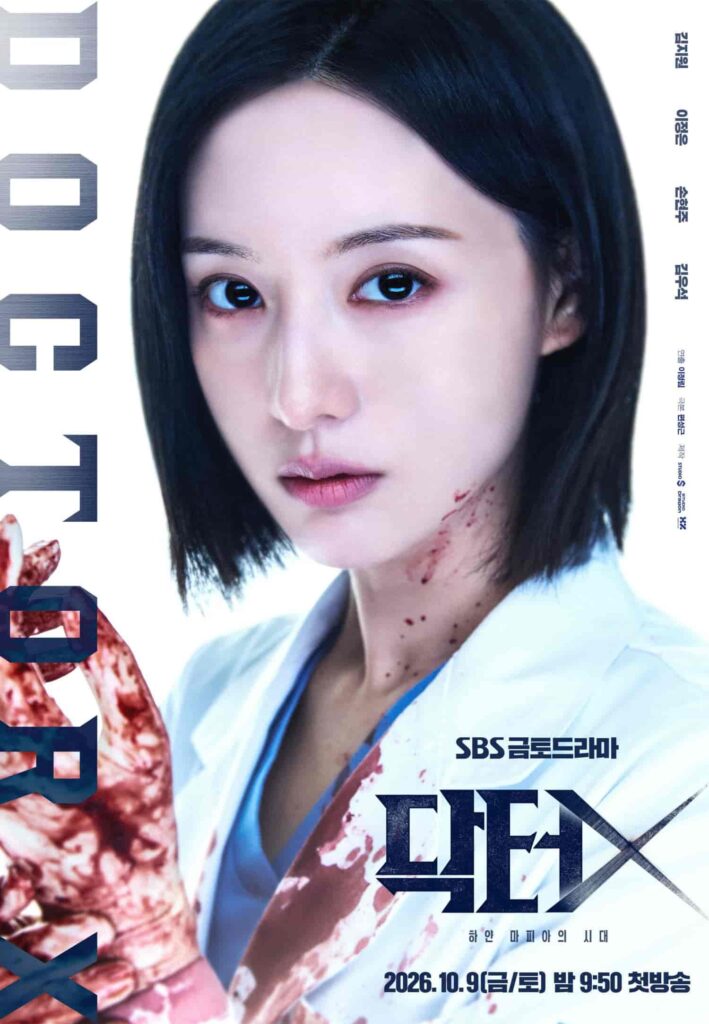
At its center is Gye Soo-jung, a fiercely skilled surgeon sent to Guseo University Hospital through a physician staffing agency.
She enters a system where professional authority and personal conviction keep colliding, then begins challenging its rules with the one advantage nobody can easily dismiss: her ability in the operating room.
Behind that premise are nine production stories involving real medical training, unexpected directing methods, cast chemistry, and one increasingly overloaded snack pouch.
Read: 9 ‘Between Steps’ Facts, When Formality Became Romantic Chemistry
1. The Drama Began With a Question About Why Hospitals Had Started Feeling Uncomfortable
Before there was a fictional medical cartel to confront, director Lee Jeong-rim and writer Pyeon Seong-geun were talking about something more ordinary: why hospitals can feel alienating at the exact moment people are physically and emotionally most vulnerable.
That discomfort became one of the ideas from which the Korean adaptation developed.
The goal was not to divide every doctor into heroes and villains. Lee Jeong-rim was interested in institutional problems such as abuses of authority and impersonal treatment, but she also found a strong belief in people running through the screenplay.
That decision matters because it keeps the medical noir from operating as a simple revenge machine; the hospital is corrupt, but the people inside it are allowed to be more complicated.
2. Kim Ji-won Practiced Surgery Until Medical Advisers Applauded Her
This is Kim Ji-won’s first role as a doctor, and the production did not rely on fast editing to hide unfamiliar hands.
She learned the surgical techniques required for the operating-room sequences directly from medical advisers and spent enough time repeating them that the movements stopped feeling foreign.
The preparation became unusually detailed. Director Lee Jeong-rim said Kim Ji-won memorized complicated surgical sequences and became highly proficient at suturing and tying knots.
The doctors advising the production were impressed enough by her work during filming to applaud.
3. The Surgery Scenes Were Designed to Reveal Character, Not Just Anatomy
Medical accuracy was only half of the assignment. Lee Jeong-rim wanted the operating room to tell viewers who Soo-jung is without interrupting the drama for explanations.
Her certainty while controlling an operation communicates one side of the character; what happens immediately afterward can reveal another.
One especially small gesture illustrates that approach. The director highlighted Soo-jung placing a hand on a patient’s chest after surgery as a way of showing her attitude toward human life.
In other words, the scalpels, sutures, and monitors were not meant to function as medical decoration—the choreography itself had to carry personality.
4. Kim Ji-won Expected a Much More Aggressive Directing Style
After watching Lee Jeong-rim’s earlier genre work, Kim Ji-won assumed the director would arrive on set with a forceful style and clearly predetermined answers.
She encountered almost the opposite. Instead of locking every scene into one interpretation, the director worked closely with the performers and allowed details to develop through discussion.
That suited Kim Ji-won’s own preparation. Lee Jeong-rim recalled the actress taking even a single line and testing multiple versions of its delivery, quietly studying minute differences in tone.
Kim Ji-won, meanwhile, said she brought different character analyses to the set and gradually built Soo-jung inside that collaborative process.
5. Kim Ji-won Started Sharing Snacks With 10 People—and Eventually Fed the Set
Her off-camera method for breaking social barriers was considerably less intimidating than Soo-jung’s bedside manner.
Kim Ji-won began carrying snacks around the set because she wanted to become comfortable with the people she was working with as quickly as possible.
At first, she distributed them to roughly 10 people around her. Then it became 20. Eventually, everyone was getting something.
The pouch contained candy, chocolate, new snacks she wanted people to try, and glucose tablets for crew members hauling heavy equipment and working up a sweat.
Lee Jung-eun remembered Kim Ji-won using her rest periods to walk around distributing food, sometimes while singing, and jokingly suggested that her co-star appeared to be spending her salary on snacks. Her managers eventually helped keep the supply operation going.
Read: 7 Facts About Dive Into You, How Two Actors Swapped Souls
6. Lee Jung-eun Was the Director’s Immediate Choice for Jang Hee-sook
When Lee Jeong-rim imagined the woman who could play Jang Hee-sook—smart, slippery, humorous, commercially minded, yet unexpectedly warm—the first actor who came to mind was Lee Jung-eun.
Casting her solved more than a performance question. Her presence apparently began serving the production in ways that resembled Hee-sook’s own role within the story.
The director said Lee Jung-eun regularly offered useful ideas not only to Kim Ji-won, but also to other performers and staff, helping stabilize the set.
It is a neat overlap between fiction and production: Hee-sook supports Soo-jung inside the drama, while Lee Jung-eun became a source of practical support around the actors and crew making it.
7. Kim Ji-won Found Her Own Version of Soo-jung’s “Safe Haven” in Lee Jung-eun
The bond between the two leads was not built entirely from scripted dialogue.
Kim Ji-won described Hee-sook as a safe haven for Soo-jung—part boss, part aunt, part friend—and said Lee Jung-eun came to occupy a similarly reassuring place for her during production.
She also described the set as somewhere she learned about both the responsibility and the pleasure of being an actor.
The admiration ran both ways. Lee Jung-eun said that when she made eye contact with Kim Ji-won during scenes, the emotional progression between the characters seemed to fill itself in naturally.
Before filming had even finished defining that partnership for viewers, the two performers had already found an unusually comfortable acting rhythm.
8. Lee Jung-eun Entered Her First Medical Noir With a Very Specific Acting Contradiction
Despite a career spanning film and television, Doctor X: Mafia in White marks Lee Jung-eun’s first medical noir.
Her character also demanded an unusual combination: Jang Hee-sook runs a physician staffing business and can treat even professionals responsible for human lives as commercial assets, yet she cannot simply feel cold or mechanical.
Lee Jung-eun therefore aimed for authority beneath Hee-sook’s relaxed, sometimes playful exterior. That tension gives the character her particular edge.
She can sound easygoing while mentally calculating the business value of the person standing in front of her—a tonal balancing act that fits a drama interested in what medicine becomes when money and power enter the room.
9. Even the First Script Reading Surprised the Production With How Quickly the Ensemble Clicked
The principal cast brought together performers who had not all worked with one another before, including Kim Ji-won, Lee Jung-eun, Son Hyun-joo, and Kim Woo-seok.
Yet the production team said the actors’ character work created a strong level of immersion even during their initial script reading.
That early chemistry became especially important because the drama depends on clashing kinds of authority.
Son Hyun-joo brings weight to hospital director Bu Seung-kwon, while Kim Woo-seok plays privileged intern Park Tae-kyung and develops a mentor-mentee dynamic with Soo-jung.
The production was therefore assembling more than a collection of individual performances; the tension had to work whenever those very different energies occupied the same room.
FAQ: Popular Questions About Doctor X: Mafia in White
Is Doctor X: Mafia in White based on a Japanese drama?
Yes. Doctor X: Mafia in White is a Korean adaptation of the hit Japanese medical series Doctor-X.
Where can you watch Doctor X: Mafia in White?
Doctor X: Mafia in White airs on SBS in South Korea and is available on Netflix in supported regions.
Who directed Doctor X: Mafia in White?
Doctor X: Mafia in White was directed by Lee Jeong-rim and written by Pyeon Seong-geun.
Final Thoughts on Doctor X: Mafia in White
Doctor X: Mafia in White is ultimately interested in the uncomfortable distance between possessing medical authority and deserving a patient’s trust.
Soo-jung’s skill gives her the power to challenge the hierarchy, but the story’s sharper question concerns what doctors choose to do once status, money, fear, and institutional loyalty enter the equation.
By combining SBS’s taste for cathartic justice dramas with medical-noir tension, the series pushes the hospital drama toward something more confrontational without losing sight of the vulnerable people underneath the machinery.
Share your favorite scene in the comments, or tell us which character has made the strongest impression on you so far.