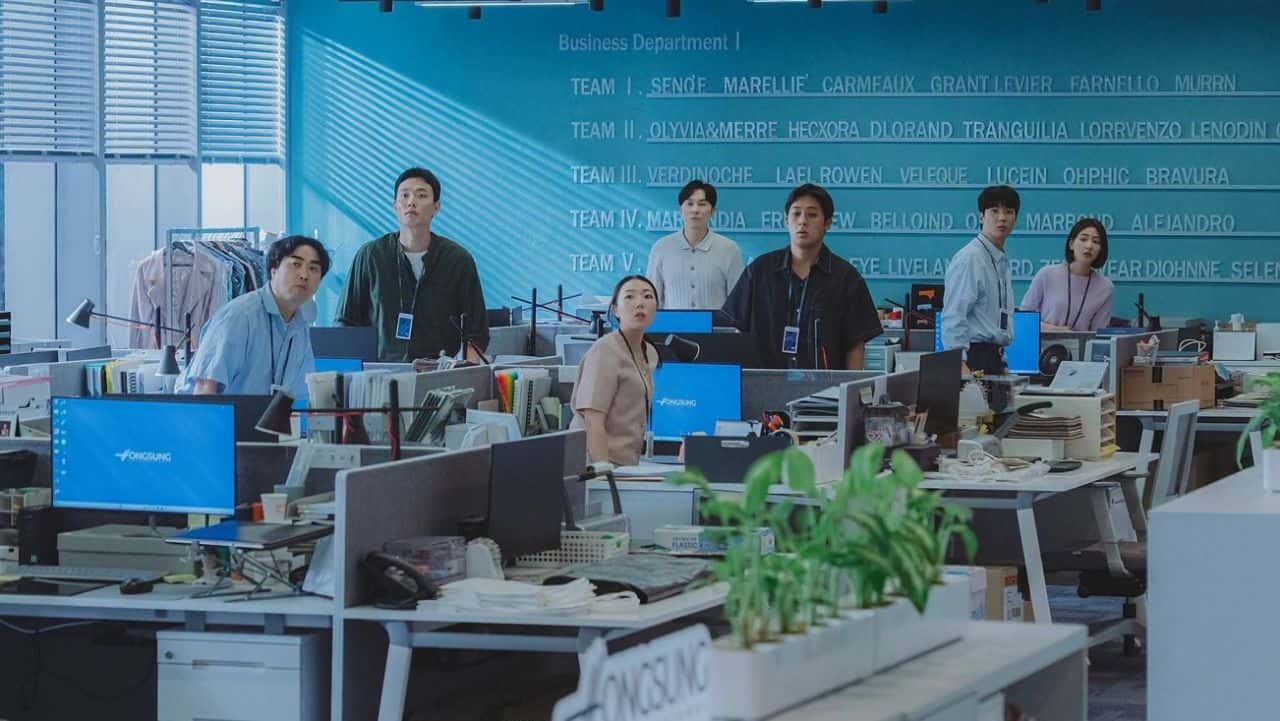
The Ordinary Jackpot has struck a nerve with viewers who recognize the exhaustion underneath its lottery fantasy.
Its appeal is not simply the prospect of getting rich; it is the possibility of walking into work without swallowing every frustration just to keep the peace.
That grounded approach has made its office politics a particularly recognizable kind of television escapism.
Gong Eun-tae, played by Lee Jun-hyuk, wins roughly 1.3 billion won but keeps his job, returning with a very different attitude toward the people around him.
The TVING series turns that shift into a story about professional pressure, self-respect, and what happens when a dependable employee stops accepting everything without question.
Behind that premise are five production choices and on-set moments that make its working world even more interesting.
1. Uee Was Encouraged to Be Rude—Then Sent Home With Flowers
Bad manners were part of the assignment. While rehearsing her guest appearance as celebrity Yoo Ji-hyun, Uee worked with Lee Jun-hyuk and the director on her character’s attitude.
His advice was blunt: she did not even need to look at him and could behave as rudely as she ever had. She laughed at the challenge before finding the tone for the scene.
Off camera, the welcome was considerably warmer. Lee Jun-hyuk thanked her for coming and encouraged the behind-the-scenes crew to give their guest plenty of attention.
After filming, the director presented Uee with flowers; she said she had prepared carefully and felt warmly supported by the praise she received.
An abrasive encounter on screen, an affectionate send-off afterward: acting did its job.
2. The Team Discussed Whether Lee Jun-hyuk Looked Too Handsome for the Job
Could an ordinary office worker look quite that much like a leading man? The question came up during casting, not just in promotional interviews.
Director Yoon Young-bin acknowledged discussions about whether audiences would identify with Lee Jun-hyuk in a role built around everyday frustrations.
His own priorities, however, were the actor’s connection to the character and his performance—not his appearance.
The director had a practical answer to those concerns. He recalled that Lee Jun-hyuk would complain about lengthy dialogue but then deliver it without stumbling, praising his exceptional diligence.
The actor, meanwhile, found Eun-tae familiar because he had spent nearly two decades continually working himself.
His route into the character was the ordinary experience of effort, pressure, and carrying on—not an attempt to pretend that a handsome person cannot have an exhausting job.
3. Cast Members Offered Up Their Own Dialogue—and Asked for Each Other’s
Line ownership was negotiable. Yoon Young-bin recalled actors approaching him to suggest that dialogue assigned to them would work better for another performer.
Just as strikingly, the reverse also happened: someone would propose taking a colleague’s line because they thought it suited their own character better. The director welcomed both kinds of suggestions as signs of genuine ensemble chemistry.
Giving a line away and asking to take one might sound contradictory. In the director’s telling, though, both came from looking at the production as a whole.
What impressed him was the combination of generosity and the confidence to speak up about a creative choice.
For a series concerned with how individuals become a functioning team, those conversations offer a revealing off-camera parallel.

4. Lee Jun-hyuk and Seo Hyun-woo Sometimes Communicated With Just a Look
A glance sometimes did the work of a conversation. Discussing his collaboration with Seo Hyun-woo, Lee Jun-hyuk described how they checked on each other’s condition and could sometimes recognize where support was needed simply by making eye contact.
He connected that understanding to their shared experience as longtime working actors, saying those moments created trust and gave him strength.
Burnout was not an abstract subject for him, either. Lee Jun-hyuk said he experienced it frequently and found encouragement in watching other actors and directors continue working through their own difficulties.
His comments give the drama’s workplace fatigue a personal context: the performers portraying it also understood the value of having a dependable colleague beside them.
5. The Director Built the Conflicts Around People Who Think They Are Right
A conventional villain was not part of Yoon Young-bin’s plan. He designed the conflicts around competing ideas of what is right, explaining that everyday friction often comes from anxiety, failed communication, or different perspectives rather than a deliberate wish to hurt someone.
His stated goal was to make an unusually realistic office drama, even with a lottery jackpot at its center.
That choice asks viewers to separate understanding a difficult colleague from agreeing with them.
Someone can behave badly without existing solely to be defeated, and a disagreement can remain painful even when both sides believe they have good reasons.
It is an approach that leaves room for resentment, embarrassment, and compromise—the uncomfortable business of sharing a workplace with people whose priorities do not match your own.
FAQ: Popular Questions About The Ordinary Jackpot
Is The Ordinary Jackpot based on a book?
Yes. The series is adapted from a web novel of the same name by Seo In-ha.
How many episodes does The Ordinary Jackpot have?
The Ordinary Jackpot has 10 episodes.
Is The Ordinary Jackpot a romantic comedy?
No. It is a workplace drama focused on colleagues, career pressures, and personal growth, rather than a central romance.
Final Thoughts on The Ordinary Jackpot
The emotional pull of The Ordinary Jackpot lies in the difference between having money and feeling able to speak.
Eun-tae’s return to work makes room for questions about dignity, loyalty, and the habits people develop simply to get through the day. The lottery changes his options; the harder task is deciding what to do with them.
As a workplace K-drama, The Ordinary Jackpot makes a compelling case for stories about changing an ordinary life without discarding it.
Leave a comment with your favorite scene, especially one that felt a little too close to your own workday.
1 thought on “5 Facts About The Ordinary Jackpot, How the Director Created Office Tension Without Villains”
Comments are closed.